





Transitioning from military life to civilian reality can be difficult. For many veterans, the weight of service follows them home in ways that are hard to put into words. If you find yourself using alcohol or substances to quiet the noise, you should know that asking for help can become the most important thing you do after service. Seeking veterans addiction treatment is not a sign of failure or weakness. It’s a chance to reclaim a life that you earned through service.
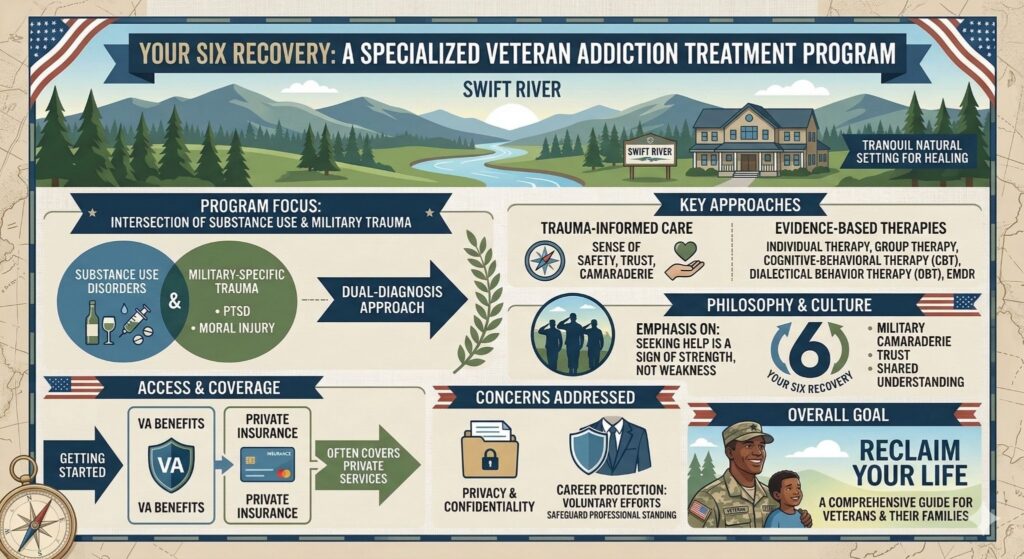
Veterans addiction treatment called Your Six Recovery at Swift River in Cummington, Massachusetts is a specialized form of healthcare that addresses substance use disorders alongside military-specific issues like PTSD, moral injury, and chronic pain. These programs use evidence-based therapies and trauma-informed care to help former service members recover in an environment that respects their unique background and culture.
Key Takeaways
- Specialized veteran programs address the root causes of addiction, including combat trauma and service-related stress.
- Dual diagnosis care is vital because many veterans struggle with co-occurring mental health conditions.
- The VA MISSION Act allows many veterans to use their benefits for private, high-quality community care.
- Privacy and career protection are central to modern treatment protocols for active and former members.
- Treatment in a natural setting, such as the Massachusetts Berkshires, provides the quiet needed for deep recovery.
Is It Time for a Change? A Quick Self-Check
If you are unsure if your substance use has reached a point that requires professional help, ask yourself these five questions. Be honest with yourself. Nobody else is watching.
- Do you use substances to numb memories or “turn off” your brain at night? (Yes/No)
- Have family members or battle buddies expressed concern about your drinking or drug use? (Yes/No)
- Do you feel like you need to use it just to feel “normal” or to get through the day? (Yes/No)
- Has your performance at work or your connection with your family started to slip? (Yes/No)
- Have you tried to cut back on your own and found that you could not stay away for long? (Yes/No)
Why Veterans Face Unique Challenges With Addiction
The military prepares you for many things, but it rarely prepares you for the silence of coming home. According to data from the SAMHSA National Survey on Drug Use and Health, veterans are more likely than civilians to experience heavy alcohol use and prescription opioid misuse. This is not because of a lack of willpower. It is because the physical and emotional toll of service creates a specific kind of pressure.
The Link Between Military Service, Trauma, and Substance Use
In the service, you learn to push through pain and ignore discomfort. While that serves you in the field, it can become a liability at home. Some veterans begin using substances as a way to manage physical injuries or the hyper-vigilance that stays with them long after they take off the uniform. What starts as a way to get a few hours of sleep can quickly turn into a cycle that feels impossible to break.
PTSD, Moral Injury, and Co-Occurring Disorders
We often talk about PTSD, but moral injury is just as real. Moral injury happens when you have to do things, or witness things, that go against your deeply held beliefs. This creates a soul-deep exhaustion. When addiction is layered on top of these experiences, it is called a co-occurring disorder. You cannot treat the addiction without addressing the trauma. If a program only looks at the drinking or the drug use, they are only seeing half the problem.
Serving Veterans Across Massachusetts
Not all rehab programs are built for the veteran experience. Look for veteran rehab in Massachusetts that understands the difference between a civilian panic attack and a service-related flashback. You need a team that knows what “the suck” feels like.
Trauma-Informed Care and Dual Diagnosis Treatment
Trauma-informed care means the staff understands how your history affects your present. They will not push you in ways that trigger a defensive response. Instead, they work with you to build safety. Dual diagnosis treatment ensures that if you have depression or anxiety alongside an addiction, both are treated at the same time.
| Feature | Inpatient/Residential Treatment | Outpatient Treatment |
| Environment | 24/7 supervised, clinical setting | Lives at home, attends sessions |
| Intensity | High; focus is entirely on recovery | Moderate; allows for work or school |
| Best For | Severe addiction, detox, or high trauma | Mild addiction or step-down care |
| Duration | 30 to 90 days typically | Varies based on progress |
MAT, Detox, and Evidence-Based Approaches
Medical Detox is often the first step. It is a safe way to clear substances from your system under the eye of medical professionals. Many veterans also benefit from Medication-Assisted Treatment (MAT). This uses FDA-approved medications to reduce cravings and prevent overdose. It is a tool, like any other piece of equipment, used to ensure you reach your objective.
Will Seeking Treatment Affect My Career, Clearance, or Record?
This is the primary fear for many. They worry that a record of treatment will end their career or result in the loss of a security clearance. In reality, the military and the VA have made massive strides in how they view mental health. Under most circumstances, seeking help voluntarily is seen as a sign of responsibility. Privacy laws like HIPAA protect your medical records. Choosing recovery often saves a career that would otherwise be lost to the consequences of an untreated addiction.
Swift River’s Veterans Support Program
At Swift River, we do things differently. We are a private treatment center located on 200 acres in the Massachusetts wilderness. We believe that healing happens when you feel safe and respected, not when you are punished.
How We Treat the Whole Veteran, Not Just the Addiction
Our Veterans Support Program is designed to be no-nonsense and effective. We use clinical tools like Cognitive Behavioral Therapy (CBT) and Dialectical Behavior Therapy (DBT), but we also use the woods. Nature is not just scenery here. It is part of the work. Whether it is hiking through the Berkshires or working through a difficult memory in the fresh air, we give you the space to breathe.
VA Benefits, Insurance, and Getting Started
You earned your benefits. We make sure you can use them. Swift River accepts VA benefits through the Community Care Network, as well as private insurance like Blue Cross Blue Shield, Cigna, and VA benefits. We handle the paperwork so you can focus on getting better. Our facility is Joint Commission accredited and SAMHSA certified, which means we meet the highest standards of clinical care.
Not Ready to Call? Take a Confidential First Step
If you want to learn more, call our admissions team at 413-923-6917 who can answer any questions, verify insurance and prepare you for your treatment.
We know that picking up the phone is the hardest part. If you are not ready to talk to someone yet, that is fine. You can visit our website to take a confidential online self-assessment. It is anonymous. It gives you a chance to see where you stand without having to explain yourself to anyone. You don’t have to call today. Just start by getting the facts for yourself.
Finding Veterans Addiction Treatment in Massachusetts and New England
If you are looking for veterans addiction treatment in Massachusetts, you have options that go beyond a standard hospital wing. Our facility in Cummington, Massachusetts, serves the entire New England region. We are far enough away from the noise of the city to provide real peace, but close enough to be accessible for families.
Why the Berkshires Setting Supports Veteran Recovery
There is something about the Massachusetts Berkshires that demands honesty. The mountains and the woods cut through your past. For a veteran who has spent years in high-stress environments, this quiet is essential. It allows the nervous system to finally power down.
It’s the type of veteran support that can make meaningful differences in your life.
FAQs About Veterans Addiction Treatment
Does the VA pay for private addiction treatment programs?
Yes. Through the VA MISSION Act and the Community Care Network, veterans can often access private residential treatment if the VA cannot provide the specific care needed or if the wait times are too long.
What is the difference between VA rehab and private veterans addiction treatment?
VA facilities are often more clinical and institutional. Private programs like Swift River tend to offer more individual attention, upscale amenities, and specialized settings like our 200-acre campus in Cummington.
Can veterans use TRICARE or VA benefits at Swift River?
We work with various insurance providers and can help you verify your VA benefits or TRICARE coverage. Our team is experienced in navigating these systems to ensure you get the care you deserve.
What does trauma-informed addiction treatment for veterans look like?
It looks like respect. It means therapists who understand the military mindset and sessions that focus on the root causes of trauma without re-traumatizing you. It is about building a foundation of safety first.
How does PTSD affect addiction and recovery for veterans?
PTSD can make the world feel like a threat. Substances are often used to manage that feeling. Recovery requires treating the PTSD and the addiction at the same time so you don’t feel the need to “self-medicate” those symptoms.
Is veterans addiction treatment confidential?
Absolutely. Federal law protects your privacy. Your treatment at a private facility is a medical matter, and we take your discretion very seriously.
Will going to rehab affect my security clearance, military career, or VA benefits?
Generally, seeking help voluntarily does not result in the loss of clearance. In fact, most agencies view it as a proactive step toward maintaining your health and reliability. It is far more common to lose a career to an active addiction than to a recovery program.
What should a veteran expect during the first week of residential rehab?
The first week is about stabilization. You will go through an assessment, begin the detox process if needed, and start to settle into the routine of the community. It is a time for your body and mind to start finding a new baseline.
How can I help a veteran who is struggling with substance use but won’t ask for help?
The best thing you can do is lead with compassion rather than judgment. Let them know you are on their side. Offer to help them research options or check their benefits. Sometimes, just knowing that a place like Swift River exists can make the idea of help feel less like a surrender.
A brighter future starts with one call. You have spent your life looking out for others. It is time to let someone look out for you. Whether you are ready to start today or just want to know what your options are, we are here to help.
Start Your Veteran Addiction Treatment in Massachusetts Today
Call our admissions team at 413-923-6917 who can answer any questions, verify insurance and prepare you for your treatment.
Swift River is located at 151 South St., Cummington, Massachusetts.
Helpful Links
If you are in immediate crisis, please use the following resources:
- VA.gov: Substance Use Disorder
- National Institute on Drug Abuse: Substance Use and Military Life
- Recovery Research Institute: Life Experiences of Veterans in Addiction
- SAMHSA National Helpline: 1-800-662-HELP (4357)
- National Suicide Prevention Lifeline: 988
- American Addiction Centers: State of Veteran Mental Health and Substance Abuse