




Finding the right help for someone you love can feel overwhelming. If you are reading this at 2:00 a.m. while your child or spouse sleeps, or doesn’t, you likely feel like you’re trying to navigate a map written in a language you don’t speak. Finding help for your loved one doesn’t have to be daunting. Swift River in Cummington, Massachusetts uses proven methods and evidence-based therapies to guide you or a loved one on a path to recovery.
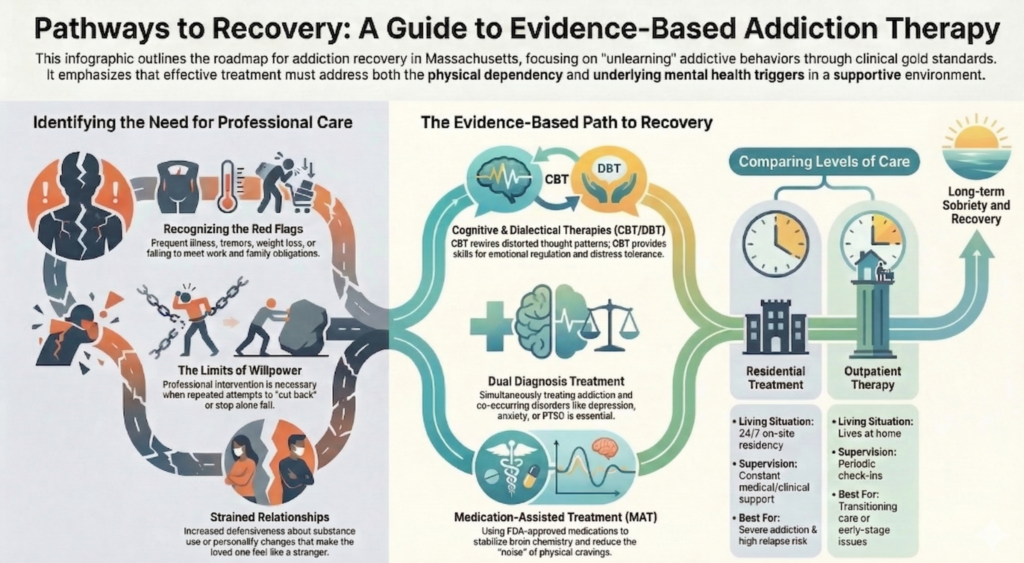
Addiction therapy in Massachusetts includes a range of evidence-based clinical approaches like Cognitive Behavioral Therapy (CBT), Dialectical Behavior Therapy (DBT), and Medication-Assisted Treatment (MAT) designed to treat both the physical dependency and the underlying mental health triggers. These programs provide a structured environment where individuals can safely detox and learn the skills needed to maintain long-term sobriety.
Key Takeaways
- Evidence-based care works. Methods like CBT and DBT are the clinical gold standard for changing the thought patterns that drive substance use.
- Dual diagnosis is essential. Effective treatment must address co-occurring disorders like depression, anxiety, or PTSD alongside the addiction.
- Environment matters. Healing is more effective in a setting that feels like a retreat rather than a hospital, particularly when nature is involved.
- Insurance often covers it. Many private plans, including Blue Cross Blue Shield and Cigna, provide coverage for residential treatment in Massachusetts.
If you’re trying to understand your options, a confidential conversation with our team can help you find clarity. No commitment is required.
What Is Drug Rehab in Massachusetts?
At its simplest, addiction therapy is a process of unlearning. It is a collaborative effort between a person and a clinical team to identify why they use substances and how to stop. In Massachusetts, high-quality therapy moves beyond just “not using” and focuses on building a life where using is no longer necessary. It involves a mix of individual counseling, group sessions, and medical support to heal the brain and the body simultaneously.
Before we get into the clinical details, take a moment to look at the current situation. It’s easy to second-guess yourself when you’re in the middle of a crisis.
Is It Time for Professional Help? A Quick Self-Check
If you answer “yes” to more than two of these, your family member likely needs a level of care that goes beyond simple willpower:
- Have they tried to stop or “cut back” on their own and failed?
- Are they missing work, school, or family obligations due to substance use?
- Is their physical health declining? Examples include weight loss, tremors, or frequent illness.
- Have you found yourself lying to others to cover for their behavior?
- Do they become angry or defensive when you mention their drinking or drug use?
- Are they experiencing withdrawal symptoms when they go a day without?
- Has their personality changed so much that they feel like a stranger?
Types of Addiction Therapy in Massachusetts
When you look at a facility’s website, you’ll see acronyms like CBT and DBT. These aren’t just buzzwords; they are the tools our clinicians use to help your loved one rebuild their life.
Cognitive Behavioral Therapy (CBT)
CBT is built on a simple idea: our thoughts, feelings, and behaviors are all connected. For someone struggling with addiction, those thoughts are often distorted. They might think, “I had a bad day, so I deserve a drink,” or “I’ve already messed up my life, so it doesn’t matter if I use today”.
In a CBT session, the therapist helps the individual catch these “automatic thoughts” before they lead to a relapse. It feels less like a lecture and more like a workshop. They look at the evidence for and against these thoughts and develop a “plan B” for when things get difficult. It is practical and goal-oriented.
Dialectical Behavior Therapy (DBT)
Originally developed to treat borderline personality disorder, DBT is incredibly effective for addiction because it focuses on emotional regulation. Many people use drugs or alcohol because their emotions feel too big to handle. They feel “flooded” by anger, shame, or grief.
DBT teaches four specific skill sets: mindfulness, distress tolerance, interpersonal effectiveness, and emotional regulation. In practice, this means your loved one learns how to sit with a craving without acting on it. They learn that they can feel a difficult emotion and survive it. At Swift River, we often find that DBT is the “missing piece” for people who have been to rehab before but couldn’t make the sobriety stick.
Motivational Interviewing
A lot of people enter treatment feeling forced or defensive. They might know they have a problem, but they aren’t sure they want to give up the substance yet. Motivational Interviewing is a non-confrontational way of talking that helps a person find their own internal reasons for change.
Instead of a doctor telling them why they should stop, in Motivational Interviewing the therapist asks questions that lead the person to realize how addiction is getting in the way of the things they actually care about, such as their kids, their career, or their self-respect. It’s about building a bridge from where they are to where they want to be.
How to Choose the Best Rehab in Massachusetts
You don’t need to become an expert in these therapies; that is what a clinical team is for. What matters is finding a place that uses all of them and knows when each one fits. Every person who walks through our doors has a different story. Some need the structured logic of CBT, while others need the emotional grounding of DBT. A clinical team should match the approach to the individual, not the other way around.
When Addiction and Mental Health Overlap: Dual Diagnosis Treatment
We rarely see addiction existing in a vacuum. Most people we treat are also battling something else: depression, anxiety, PTSD, or borderline personality disorder. This is what we call a dual diagnosis or co-occurring disorders.
If you only treat the addiction and ignore the depression, the person will likely return to drugs the next time their mood crashes. If you only treat the PTSD and ignore the alcohol use, they won’t be sober enough to do the hard work of trauma recovery.
According to SAMHSA’s National Survey on Drug Use and Health, millions of adults experience both mental illness and a substance use disorder simultaneously. Real recovery requires a team that can manage both at the same time, in the same place. This is a core part of what we do in the Berkshires. We treat the whole person, because you can’t pull one thread without affecting the others.
Medication-Assisted Treatment (MAT): What Families Should Know
There is a common fear among parents that MAT, using medications like Suboxone or Vivitrol, is just “trading one drug for another”. We understand that concern, but the clinical reality is different.
Addiction changes the brain’s chemistry. For someone with a severe opioid or alcohol use disorder, the cravings aren’t just “in their head”; they are a physical emergency. MAT helps stabilize that chemistry. It lowers the “noise” of cravings and prevents painful withdrawal symptoms so the person can actually focus on their therapy.
Think of it like a cast for a broken leg. The cast doesn’t heal the bone (the body does), but the cast holds everything in place so healing can happen. MAT is a proven, evidence-based tool that saves lives and reduces the risk of overdose.
How to Know When It’s Time to Seek Professional Help
If you’re reading this at 2 a.m. wondering whether it’s really that bad, it is okay to trust that instinct. You wouldn’t be here if things were going well. We often see families who have spent years in a cycle of “one more chance.” They wait for a “rock bottom” that never seems to arrive, or that looks more like a tragedy than a turning point.
Reaching out isn’t giving up on your son, your daughter, or your spouse. It is fighting for them. It is admitting that this disease is bigger than your love for them, and it requires professional intervention.
Choosing the Right Level of Care
Not every person needs the same environment. Here is a simple breakdown of the two most common options:
| Feature | Residential Treatment (Inpatient) | Outpatient Therapy |
| Living Situation | Lives at the facility 24/7 | Lives at home, attends sessions |
| Supervision | 24-hour medical & clinical support | Periodic check-ins |
| Environment | Completely drug-free, immersed in nature | Exposed to daily stressors and triggers |
| Best For | Severe addiction, dual diagnosis, high relapse risk | Early-stage issues, transition after residential |
| Intensity | Full-time focus on recovery | Part-time (usually 9–15 hours/week) |
A Continuum of Care in Massachusetts
Massachusetts is home to some of the best clinical care in the country, but the environment where that care happens matters just as much as the therapy itself.
In Western Massachusetts, we have something the city facilities don’t: space. At Swift River in Cummington, our 80-acre campus in the Berkshires isn’t just a pretty view. It’s part of the clinical process. When a person is struggling with PTSD or severe anxiety, the quiet of the woods and the rhythm of the natural world can do what a sterile hospital wing cannot. It allows the nervous system to finally settle.
When looking for a program, ensure they offer:
- A Full Continuum of Care: From medical detox to virtual aftercare.
- Accreditation: Look for the Joint Commission seal.
- Accessibility: They should work with major insurers like Blue Cross Blue Shield and Cigna.
- Specialized Programs: Such as our Veterans Support Program, which addresses the specific trauma and experiences of those who served.
If your loved one is dealing with both addiction and a mental health condition, Swift River’s dual diagnosis program was built exactly for this. Reach out to learn more.
Frequently Asked Questions
What types of therapy are used to treat addiction?
The most common evidence-based therapies are Cognitive Behavioral Therapy (CBT), Dialectical Behavior Therapy (DBT), and Motivational Interviewing. These are often combined with group therapy, family counseling, and experiential treatments like art or nature-based therapy to provide a well-rounded approach.
How long does addiction therapy take to work?
Recovery is a lifelong process, but residential programs typically last between 30 and 90 days. The initial weeks focus on stabilization and detox, while the following months focus on deep-seated behavioral changes and relapse prevention planning.
Can therapy alone treat addiction, or is medication also needed?
It depends on the individual and the substance. For many, therapy is enough. However, for those with severe opioid or alcohol dependencies, Medication-Assisted Treatment (MAT) combined with therapy is often the most effective path to preventing overdose and maintaining long-term sobriety.
What is dual diagnosis treatment and does my loved one need it?
Dual diagnosis treatment is for people who have both a substance use disorder and a mental health condition, such as depression or PTSD. If your loved one uses substances to cope with their mood or past trauma, they likely need dual diagnosis care to address both issues simultaneously.
Is CBT or DBT better for addiction recovery?
Neither is “better” in a vacuum; they serve different purposes. CBT is excellent for identifying and changing logic-based thought patterns, while DBT is superior for people who struggle with intense emotional swings and need skills to manage distress. Many successful programs use both.
Does insurance cover addiction therapy in Massachusetts?
Yes, most private insurance plans are required to cover addiction treatment under the Mental Health Parity and Addiction Equity Act. At Swift River, we accept many major providers, including Blue Cross Blue Shield, Cigna, and VA benefits.
A brighter future is closer than it feels. Whether you are ready to start the admissions process or just need someone to listen to your story, we are one call away. Your identity, your history, and your journey are welcome here. It’s time to breathe again.
Start Your Addiction Rehab Today
Call our admission team at 413-570-9698 and verify insurance today.
Swift River is located at 151 South St., Cummington, Massachusetts.
Safety Resources
- SAMHSA National Helpline: 1-800-662-HELP (4357)
- Mass.gov: Substance Use and Overdose Data
- National Suicide Prevention Lifeline: 988
- Crisis Text Line: Text HOME to 741741
- Mayo Clinic: Cognitive Behavioral Therapy
- Cleveland Clinic: Dialectical Behavior Therapy
- Psychology Today: Motivational Interviewing