





When you are looking for a residential treatment center for your loved one, you likely have one primary question: What will their day actually look like? You have heard of Alcoholics Anonymous (AA) or Narcotics Anonymous (NA), and you know the “12 steps” are a staple of recovery. However, you might wonder if rehab is just one long meeting or if these programs are clinical enough to handle a serious addiction.
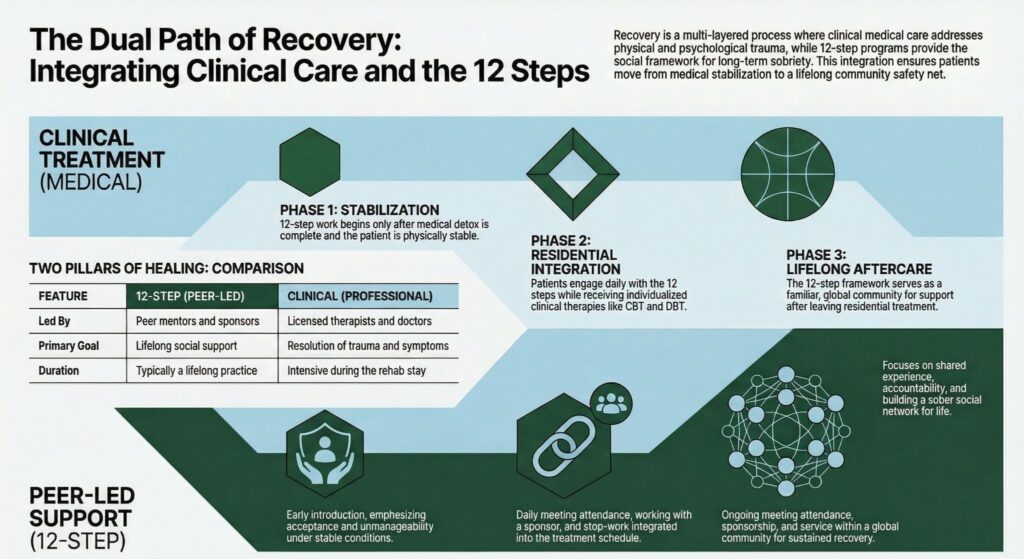
In a professional residential setting, a 12-step program is a peer-led support framework that works alongside medical treatment to help individuals build a sober social network. It is not a replacement for therapy. Instead, it is a community-based tool that provides a roadmap for life after treatment. Most people begin engaging with these groups once they are medically stable and out of the intensive detox phase.
Key Takeaways
- Timing: 12-step participation usually begins in the residential phase of treatment once medical detox is complete.
- Role: It serves as a social and spiritual framework that complements clinical therapies like CBT and DBT.
- Flexibility: While highly encouraged, 12-step is one of several peer support options available to help maintain long-term sobriety.
- Aftercare: The primary benefit of starting in rehab is that it connects the individual to a global community they can access anywhere after they leave.
- Swift River Approach: We integrate these meetings into a broader, individualized plan that includes nature-based healing and dual diagnosis care in the Berkshires.
Is Your Loved One Ready for Peer Support?
Before diving into the steps, it helps to know if this approach fits your current situation. Consider these questions:
- Does my loved one feel like no one understands what they are going through?
- Are they looking for a sense of community outside of a clinical doctor-patient relationship?
- Have they struggled to maintain sobriety in the past once they returned home?
- Do they need a structured “instruction manual” for how to live a sober life?
- Are they physically and mentally stable enough to participate in group discussions?
What Is a 12-Step Program: How Does It Fit Into Rehab?
A 12-step program is a structured, peer-to-peer support system designed to help people achieve and maintain abstinence from substances. Founded on the principles of AA, it involves admitting powerlessness over an addiction and following a series of stages to make amends and seek personal growth. In a rehab setting, this is not the only thing happening. It is a vital layer of support that sits on top of medical detox and evidence-based clinical care.
Rehab centers use the 12 steps to bridge the gap between the facility and the real world. While doctors manage the physical symptoms of withdrawal and therapists address the underlying trauma, the 12-step community provides the social support that keeps a person grounded.
When Does 12-Step Begin During the Treatment Process?
Recovery is not a race, and the timing of each phase depends on the person’s health and history. Most treatment programs in Western Massachusetts follow a specific progression.
During Detox
During the first few days of medical detox, the focus is almost entirely on safety and physical comfort. Withdrawal can be grueling. At Swift River, we ensure this process is as painless as possible. Because a person in detox is often dealing with intense physical discomfort or cognitive fog, formal 12-step work is rarely the priority. They might attend a low-pressure introductory meeting if they feel up to it, but the heavy lifting of the steps usually waits until the body is clear of substances.
During Residential Treatment
This is where the work really happens. Once a person moves into our residential program in Cummington, they have the mental clarity to engage with the steps. In this phase, 12-step meetings are often held daily or several times a week. Residents begin to understand the vocabulary of recovery and may even start working with a temporary sponsor, who is a peer further along in the journey who can offer guidance.
In Aftercare and Beyond
The 12 steps are designed for the long haul in alcohol addiction. As a person prepares to leave the Berkshires and return to their daily life, the 12-step framework becomes their primary safety net. Whether they are returning to Boston, Springfield, or elsewhere, they can find an AA or NA meeting nearby. This continuity is why we introduce the program early. We want it to feel like a familiar habit by the time they go home.
Effectiveness of 12-step in Residential Care
There is no single path to sobriety. For some, the spiritual or community aspect of AA is exactly what was missing. For others, particularly those who prefer a more secular or cognitive-heavy approach, 12-step might feel less intuitive.
A 2020 Cochrane Library study found 12-step programs were more effective than other therapy-based approaches among 10,000 participants.
The best rehab programs are those that offer choices. If you or your child are skeptical of the “Higher Power” language often used in the 12 steps, it is okay. Modern recovery has evolved. Many people use the steps as a psychological tool rather than a religious one. At Swift River, we emphasize that treatment is individualized. We combine these peer groups with clinical modalities to ensure every angle of the addiction is addressed.
12-Step vs. Clinical Therapy
| Feature | 12-Step Programs (AA/NA) | Clinical Treatment (CBT/DBT) |
| Led By | Peer mentors and sponsors | Licensed therapists and doctors |
| Primary Focus | Shared experience and accountability | Identifying triggers and behavioral change |
| Setting | Group-based, community circles | Individual or small group clinical sessions |
| Goal | Lifelong social support system | Resolution of trauma and mental health symptoms |
| Duration | Typically a lifelong practice | Usually intensive during the rehab stay |
How Swift River Integrates 12-Step Into Individualized Treatment
At Swift River, we believe that healing requires more than just a hospital bed. Our facility sits on 200+ acres in the heart of the Berkshires. Here, nature is a central part of the recovery process.
We integrate 12-step principles into a broader continuum of care that includes:
- Medical Detox: A safe, comfortable start to the journey.
- Dual Diagnosis Care: We specialize in treating addiction alongside PTSD, anxiety, and depression.
- Nature-Based Healing: Using our expansive Massachusetts wilderness for reflection and exercise.
- Evidence-Based Therapy: Utilizing Dialectical Behavior Therapy (DBT) and Cognitive Behavioral Therapy (CBT).
We host regular meetings right here on our campus in Cummington, MA. This allows our residents to practice the 12 steps in a safe, secluded environment before they have to navigate the stresses of the outside world. We also recognize that many of our residents are veterans. Our Veterans Support Program ensures that those who have served find a community that understands the specific trauma and challenges associated with military service.
If you are a parent or spouse worried about whether this will feel like a punishment, we invite you to see things differently. We accept most major insurances, including Blue Cross Blue Shield and Cigna, because we believe high-quality, comfortable care should be accessible. Your loved one can have clinical rigor and a beautiful place to heal at the same time.
Confidential Help is Available: Every recovery journey is different. Our team can help you understand which approaches fit best for your family. Call us today 413-471-8881 for a free, confidential assessment. You can verify your insurance online.
Frequently Asked Questions
Do you have to do a 12-step program in rehab?
Most quality rehab programs highly encourage 12-step participation because it is an evidence-based way to prevent relapse after you leave. However, it is usually one part of a larger plan. If 12-step is not a fit, there are other peer-support options, like SMART Recovery, that can be explored.
When in the rehab process does 12-step typically start?
Formal meetings usually begin once the patient has completed medical detox and is stable enough to participate in groups. This is typically within the first week of entering residential treatment.
What is the difference between 12-step and non-12-step rehab programs?
12-step programs rely on a specific series of spiritual and social milestones and peer support. Non-12-step programs often focus more on self-empowerment, cognitive-behavioral techniques, and secular methods for managing addiction.
Can 12-step meetings help with dual diagnosis conditions like depression or PTSD?
Yes, but only when used in conjunction with clinical therapy. 12-step meetings provide the community and accountability needed for sobriety, while licensed therapists at Swift River address the clinical symptoms of PTSD or depression through targeted treatments like DBT.
Does insurance cover rehab programs that include 12-step?
Yes. Insurance providers like BCBS, Cigna, and Harvard Pilgrim typically cover the clinical costs of residential treatment programs that incorporate 12-step meetings as part of their comprehensive care model.
Are 12-step meetings required or optional at Swift River?
While we believe strongly in the power of peer support, we treat every person as an individual. We work with you to find the path that you are most likely to stick with, whether that includes traditional 12-step work or other evidence-based alternatives.
How does Swift River combine 12-step with other therapies like CBT and DBT?
We view 12-step as the social pillar of recovery and CBT/DBT as the clinical pillar. In the morning, a resident might work with a therapist on emotional regulation. In the evening, they might attend a 12-step meeting to share their progress with peers.
Recovery is possible, and it starts with finding the right fit for your story. In the quiet of the Berkshires, there is space to breathe and room to become someone new. If you are ready to take that first step toward a brighter future, we are one call away.
Start Your Recovery in Massachusetts Today
Call our admissions team at 413-471-8881.
Swift River is located at 151 South St., Cummington, Massachusetts.
Helpful Links
- SAMHSA National Helpline: 1-800-662-HELP (4357)
- National Suicide Prevention Lifeline: 988
- Alcoholics Anonymous: 12-step Program
- AMA Journal of Ethics: Addiction, 12-step Programs
- PubMed Central: 12-step Intervention
- Crisis Text Line: Text HOME to 741741
- Cochrane Collaboration: 12-step Recovery Process