






Watching someone you love struggle with addiction can take a toll on you. It’s likely you have spent months or years going between frantic rescue missions and periods of cold silence. If you are considering residential treatment for your child or spouse, you probably have a hundred questions about what happens behind closed doors. You might even feel a sense of dread about your own role in the process.
Family therapy in addiction treatment is a collaborative process where a therapist works with both the individual in recovery and their loved ones to repair relationships and improve communication. It focuses on the family as a system, identifying patterns that may unintentionally support substance use while building a healthier environment for long-term sobriety. At Swift River in Cummington, we treat the family as an essential part of the healing team.
Key Takeaways
- Repairing trust: Therapy provides a safe space to address the damage caused by addiction without the conversation devolving into an argument.
- Understanding the “System”: Addiction affects everyone in the house, and healing requires everyone to learn new ways of interacting.
- Education: Families learn the clinical reality of substance use disorders, which helps move the conversation from “why are they doing this to me” to “how do we move forward.”
- No Blame: The goal is never to find a “guilty” party but to find a path toward a healthier future together.
Is My Family Dynamic Impacted? A Quick Self-Check
Ask yourself these questions to see if your family might benefit from professional support:
- Do you find yourself lying to others to cover up your loved one’s substance use? (Yes/No)
- Is the majority of your emotional energy spent worrying about or monitoring your family member? (Yes/No)
- Have you stopped inviting people over because you are unsure of your loved one’s behavior? (Yes/No)
- Do you feel like you have to “walk on eggshells” to avoid a conflict or a relapse? (Yes/No)
- Have you neglected your own health or hobbies to manage someone else’s crisis? (Yes/No)
- Does the person struggling with addiction blame you for their choices? (Yes/No)
If you answered “yes” to more than two of these, addiction has likely shifted your family’s foundation. This is normal, and it is also fixable.
What Is Family Therapy in Addiction Treatment?
Family therapy is a specific type of counseling that views the person struggling with addiction not as an isolated problem, but as part of a larger unit. It is a clinical intervention designed to improve the interactions between family members. Instead of focusing solely on the “addict,” the therapist looks at how the family communicates, sets boundaries, and handles stress.
The goal is to move away from the chaos of active addiction and toward a stable, supportive environment. This isn’t just about the person in the program staying sober. It is about the parents, spouses, and siblings regaining their own lives.
Family involvement in addiction treatment
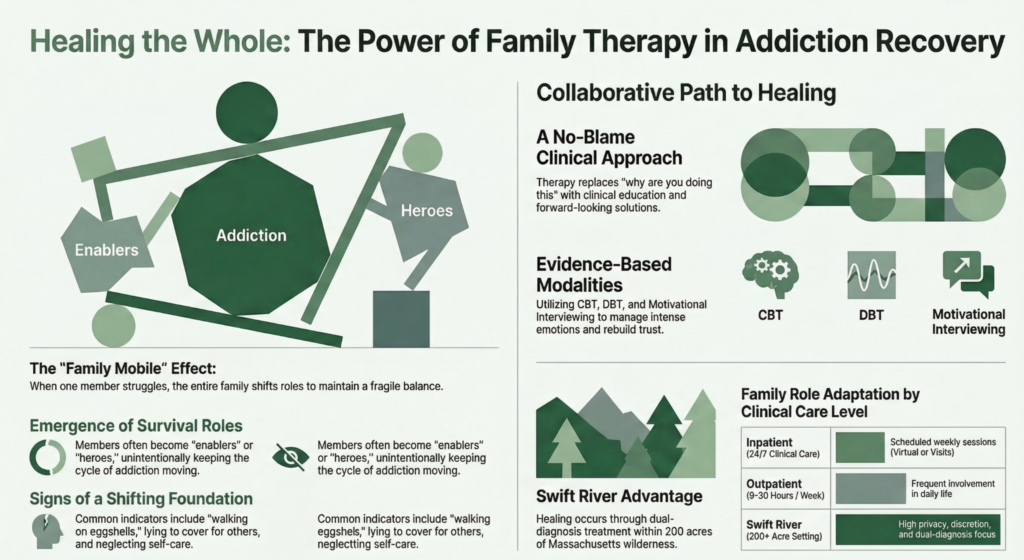
When one person in a family develops a substance use disorder, every other person in that system adjusts to compensate. It is like a mobile hanging from a ceiling: pull on one string, and every other piece shifts to maintain balance.
How Addiction Affects the Whole Family System
In many families, roles start to emerge. One person becomes the “enabler” who tries to soften the consequences of addiction. Another might be the “hero” who tries to make the family look perfect from the outside. These roles are survival mechanisms, but they often keep the cycle of addiction moving. Family therapy helps everyone step out of these rigid roles and back into being themselves.
What Families Gain from Participating
Participants often find that their own anxiety levels drop. When you understand the science of addiction, the behavior feels less like a personal attack. You gain tools to set boundaries that actually stick. More importantly, you get a chance to be heard. In the heat of active addiction, the family’s needs are often pushed aside. Therapy brings those needs back to the center.
Will I Be Blamed for My Loved One’s Addiction?
This is the question almost every parent carries into the room. You may have spent nights wondering what you did wrong or where you failed.
We want to be clear: you did not cause this. Addiction is a complex disease influenced by genetics, biology, and environment. Family therapy is not a “blame session.” It is not a place for a therapist to point a finger at your parenting style or your marriage.
Evidence-based treatment focuses on healing patterns together. A good therapist knows that you are likely hurting as much as the person in treatment. The sessions are designed to move you from a place of guilt to a place of agency. You cannot change the past, but you can change how you show up for the recovery process today.
Understanding Treatment Options
Deciding on the right level of care can feel overwhelming. Here is how family involvement typically looks across different programs:
| Feature | Inpatient / Residential | Outpatient (IOP / PHP) |
| Intensity | 24/7 care in a clinical setting | 9 to 30 hours of therapy per week |
| Family Role | Scheduled weekly sessions (often virtual or weekend visits) | Frequent family involvement in daily life |
| Best For | High-risk detox and early stabilization | Transitioning back to work or school |
| Setting | Protected environment (like Swift River’s 200+ acres) | Living at home while attending treatment |
Curious whether Swift River’s family program is the right fit? Reach out to us. We will walk you through it.
Want to learn more about Swift River? Insurance verification takes minutes.
Family therapy for addiction treatment in Massachusetts
Walking into a therapy session for the first time is intimidating. Knowing the structure can help settle those nerves.
Common Modalities Used
We use several proven methods to help families navigate these conversations:
- CBT (Cognitive Behavioral Therapy): This helps families identify negative thought patterns and replace them with constructive actions.
- DBT (Dialectical Behavior Behavior Therapy): Great for managing intense emotions and learning how to handle a crisis without blowing up.
- Motivational Interviewing: This focuses on finding the family’s internal motivation to change rather than just following a list of rules.
What a Typical Session Looks Like
A session usually lasts about an hour. The therapist acts as a neutral guide. They might start by asking each person how they have been feeling since the last meeting. You might practice “I” statements, such as “I feel scared when you don’t answer your phone,” rather than “You are being irresponsible.”
It is a controlled environment. If things get too heated, the therapist will step in to de-escalate. The goal is to leave the room feeling like you’ve made a small, manageable bit of progress, even if the conversation was difficult.
Family Therapy at Swift River: What Sets Our Approach Apart
Our facility in Cummington is located on 200 acres of Massachusetts wilderness. We believe that space matters. When families come to the Berkshires for sessions, they are stepping away from the “noise” of their daily lives in the Pioneer Valley or the Springfield metro area.
Nature is part of the treatment here. Healing happens faster when you aren’t in a sterile, hospital-like room. We specialize in dual diagnosis, meaning we look at the addiction and the underlying mental health issues, like PTSD or anxiety, at the same time. This is vital for families because often the “addiction” is just the visible symptom of a deeper hurt.
Privacy and Discretion in the Family Therapy Process
We understand that for many of our clients, particularly professionals or those in high-profile roles, privacy is the top priority. You may worry about how family involvement might disrupt your career or your standing in the community.
Swift River protects your confidentiality with absolute rigor. We offer flexible scheduling and virtual participation options through our aftercare platform. This allows you to stay involved in the healing process without having to explain your absence to colleagues or neighbors. Our goal is to protect your family’s dignity while you do the work of getting well.
Frequently Asked Questions
Do I have to participate in family therapy if my loved one is in rehab?
While it is not mandatory, it is highly recommended. Statistics from SAMHSA’s National Survey on Drug Use and Health show that recovery outcomes are significantly better when the family is involved. If you are not ready, that is okay. We meet you where you are.
What happens during a family therapy session?
The therapist facilitates a conversation between you and your loved one. You will discuss communication barriers, learn about the biology of addiction, and work on specific strategies for when they return home.
How does family therapy help with recovery from addiction?
It reduces the stress within the home. When everyone is on the same page regarding boundaries and triggers, the person in recovery is less likely to return to old, destructive habits.
Is family therapy covered by insurance for addiction treatment?
Most major insurance providers, including Blue Cross Blue Shield, Cigna, and VA benefits, cover family therapy as part of a comprehensive addiction treatment plan. We can verify your benefits for you during our first call.
What if my family member refuses to let me participate?
Privacy laws (HIPAA) mean the patient must give consent for family involvement. If they refuse initially, our clinical team works with them to understand why. Often, as they feel safer in treatment, they become more open to bringing their family in.
Can family therapy help even if the relationship is badly damaged?
Yes. In fact, that is when it is most needed. We work with families who haven’t spoken in years. The process is slow, but it provides a structured way to begin making amends.
Can I participate in family therapy sessions virtually?
Yes. We offer virtual sessions to accommodate families who live outside Western Massachusetts or those who need extra privacy.
Start Your Admission to Family Therapy in Massachusetts Now
A brighter future for your family starts with one call. We’re here when you’re ready. Not ready for a call? Fill out our contact us form.
Swift River is located at 151 South St., Cummington, Massachusetts.
To learn more about Swift River, visit our about us page.
Helpful Links
- SAMHSA National Helpline: 1-800-662-HELP (4357)
- National Suicide Prevention Lifeline: 988
- Partnership to End Addiction: Family Therapy for Addiction
- National Institute of Health: Family Counseling Approaches
- American Addiction Centers: Family Therapy for Substance Use Disorder
- Crisis Text Line: Text HOME to 741741