





If you keep asking whether the signs you need inpatient rehab are adding up, the honest answer is usually simpler than it feels: when outpatient treatment repeatedly fails to hold your sobriety, a higher level of care is often the clinically indicated next step. Outpatient care is treatment you attend while living at home, fitting sessions around work and family. Inpatient or residential rehab is treatment where you live on-site with 24-hour support, removed from the triggers and stressors that keep pulling you back. Stepping up is a matter of matching care to what recovery actually requires. It’s progress, not failure.
What “Outpatient Isn’t Enough” Actually Means
Outpatient treatment is a level of care where you attend counseling, group therapy, and sometimes medication management on a schedule while continuing to live at home. It works well for many people, especially those with strong support, stable housing, and milder substance use. Inpatient or residential treatment is a level of care where you stay at a licensed facility around the clock, with medical and clinical staff available at all hours and a structured daily program built entirely around recovery.
Saying outpatient “isn’t enough” is not a judgment about effort or character. It’s a clinical observation. The American Society of Addiction Medicine, whose ASAM Criteria set the standard for matching people to the right intensity of treatment, describes level of care as something clinicians reassess as a person’s needs change. When someone attends outpatient sessions faithfully and still relapses soon after each one, that pattern is data. It tells the treatment team that the current level of support isn’t matching the severity of what the person is facing.
The National Institute on Drug Abuse frames relapse the same way. According to the National Institute on Drug Abuse, addiction is a chronic, treatable medical condition, and relapse rates are comparable to those for other chronic illnesses like hypertension and asthma. A return to use signals that treatment needs to be resumed or adjusted, often to a more intensive level.
Quick Self-Check: Is It Time for Inpatient Care?
This short self-check can help you sort out whether a higher level of care might be the right conversation to have with a clinician. It’s a starting point for reflection, not a diagnosis. If you answer yes to several of these, it’s worth talking to a treatment professional.
- Have you relapsed soon after outpatient sessions, sometimes within days?
- Do you find it nearly impossible to stay sober in your current home environment?
- Do you experience withdrawal symptoms when you try to stop, such as shaking, sweating, nausea, or anxiety?
- Are you living with depression, anxiety, PTSD, or another condition alongside substance use?
- Is your home environment unsafe, chaotic, or full of triggers you can’t avoid?
- Has your use been escalating, needing more of a substance to feel the same effect?
- Have you missed work, school, or family obligations because of substance use?
None of these answers seal a decision on their own. Together they paint a picture, and a clinician can help you read it clearly. Withdrawal symptoms in particular deserve prompt attention, because some, especially from alcohol and benzodiazepines, can become medically dangerous without supervision.
How Clinicians Decide the Right Level of Care
Good treatment centers don’t guess at intensity. They use a structured framework, and at Swift River that framework is the ASAM Criteria, the most widely used set of standards in addiction medicine for placing people at the right level of care.
The ASAM Levels of Care, Briefly
The ASAM Criteria describe a continuum of treatment intensity rather than a single yes-or-no choice. According to the American Society of Addiction Medicine, the levels run from outpatient services through intensive outpatient and partial hospitalization up to residential and medically managed inpatient care. Clinicians assess several dimensions, including withdrawal risk, physical health, emotional and behavioral conditions, readiness to change, relapse potential, and the recovery environment at home. The level that matches a person’s needs today can shift as those needs change. Someone who begins with medically supervised detox may step down to residential care and later to outpatient support, or move up if a lower level isn’t holding.
Why “More Intensive” Sometimes Means “More Effective”
A more intensive level of care removes the daily variables that undermine recovery at home. Research summarized by the National Institute on Drug Abuse in its Principles of Effective Treatment shows that remaining in treatment for an adequate period is one of the strongest predictors of a good outcome, and that treatment should address the whole person. Inpatient care makes both easier. It holds a person in a structured, substance-free setting long enough for the early, fragile weeks of recovery to stabilize, and it surrounds them with the medical, psychological, and social support that outpatient schedules can only offer in pieces.
Outpatient vs Inpatient: A Side-by-Side Look
Residential treatment vs outpatient isn’t a ranking of better and worse. Each fits a different set of circumstances. Understanding when each one works helps you and a clinician choose well.
When Outpatient Treatment Works Well
Outpatient care is a strong fit when the foundation for recovery is already in place. It tends to work well for people with milder or shorter substance use histories, a stable and supportive home, reliable transportation, and no significant withdrawal risk. It lets a person keep working, stay close to family, and apply what they learn in therapy to real life as they go. For many people, especially those stepping down after a higher level of care, outpatient treatment is exactly the right amount of support to maintain momentum.
When Inpatient or Residential Care Is the Better Fit
Inpatient or residential care becomes the better fit when the home environment can’t support sobriety, when withdrawal needs medical supervision, when relapse keeps happening between sessions, or when a co-occurring mental health condition is driving the substance use. It’s also the safer choice when use has escalated to the point that stopping suddenly could be dangerous. Living on-site removes the triggers and the access that make early recovery so hard at home, and it provides round-the-clock support during the period when the risk of relapse is highest. Swift River offers inpatient and residential treatment for exactly these situations, where the intensity of support matches the intensity of what a person is up against.
The Hidden Risk: Co-Occurring Conditions
One of the most common reasons outpatient treatment doesn’t hold is an untreated condition underneath the substance use. Depression, anxiety, PTSD, and eating disorders frequently travel alongside addiction, and when only the substance use gets treated, the underlying condition keeps pulling a person back toward relapse. According to the Substance Abuse and Mental Health Services Administration, co-occurring substance use and mental health disorders are common, and the most effective approach treats both conditions at the same time rather than one after the other.
This is where the intensity of inpatient care matters most. Treating a co-occurring disorder well requires coordinated psychiatric and addiction care, consistent medication management when appropriate, and enough time to address the trauma or mood disorder that outpatient sessions can only touch briefly. Swift River specializes in co-occurring disorder treatment, treating addiction and the conditions tangled up with it for their comorbid relationship rather than in isolation.
If outpatient hasn’t held, a conversation about the right level of care can help. There’s no obligation in asking, and the earlier the question gets answered, the sooner the right support can begin.
What Inpatient Rehab Looks Like at Swift River
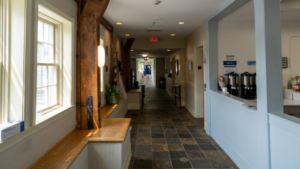
Swift River’s inpatient program sits on a quiet campus in Cummington, in the western Massachusetts countryside of the Berkshires. The setting is part of the treatment. Away from the daily stressors and triggers of ordinary life, clients get a focused, immersive experience with room to breathe and space to heal.
Care usually begins with medically supervised detox, which is facility-based on the Cummington campus and monitored by clinical staff so that the physical process of withdrawal is as safe and comfortable as possible. From there, clients move into residential treatment built around evidence-based therapies including CBT, DBT, and individual, group, and family therapy, with weekly family sessions to help rebuild the relationships addiction strains. The campus includes an on-site wellness center and a licensed dietitian, because recovery involves the whole body, and animal-assisted therapy is available as one part of the clinical program. For clients whose care team determines it’s appropriate, medication-assisted treatment is one clinician-determined option rather than a default. Support is available 24 hours a day, every day.
Taking the Next Step in Massachusetts
Choosing inpatient rehab in Massachusetts after outpatient hasn’t held is a step forward, not a step back. It means matching the level of care to what recovery genuinely requires, and that kind of clinical matching is often what finally makes recovery stick.
Cost is one of the first worries for most families, and it shouldn’t be a barrier to getting the right care. Swift River accepts a broad range of insurance plans, including Blue Cross Blue Shield and VA benefits, and the team can check your coverage quickly and confidentially. You can verify your insurance in a few minutes to understand your options. Addiction stops here. We’re one call away, and the team walks alongside you every step of the way.
Frequently Asked Questions
How Do I Know If I Need Inpatient Rehab Instead of Outpatient?
You likely need inpatient rehab when outpatient treatment hasn’t held your sobriety, when your home environment can’t support recovery, when you experience withdrawal symptoms, or when a co-occurring mental health condition is driving your substance use. The clearest sign is a repeating pattern of relapse soon after outpatient sessions. A clinician using the ASAM Criteria can assess your situation across several dimensions and recommend the level of care that fits.
Does Relapsing Mean Outpatient Treatment Failed?
No. The National Institute on Drug Abuse describes relapse as a normal part of a chronic condition, with rates comparable to other chronic illnesses like hypertension and asthma. A return to use signals that treatment needs to be resumed or adjusted, often to a more intensive level, rather than that treatment or the person failed. Relapse is information that helps a treatment team match care more accurately.
How Long Does Inpatient Rehab in Massachusetts Usually Last?
Inpatient rehab length varies by individual needs, but many residential programs run around 30 days, with some extending to 60 or 90 days depending on progress and clinical assessment. The National Institute on Drug Abuse notes that remaining in treatment for an adequate period of time is one of the strongest predictors of a good outcome. Your care team reviews your progress regularly and adjusts the plan as your needs change.
Can I Go Straight to Inpatient Rehab Without Trying Outpatient First?
Yes. There’s no rule that you must try outpatient before inpatient care. Level of care is based on clinical need, not on a required sequence. If your situation involves withdrawal risk, an unsafe home environment, a co-occurring condition, or severe substance use, a clinician may recommend starting at a higher level of care from the beginning.
Will My Insurance Cover Inpatient Rehab in Massachusetts?
Many insurance plans cover inpatient addiction treatment, and Swift River accepts a broad range of carriers including Blue Cross Blue Shield and VA benefits. Coverage details depend on your specific plan, so the fastest way to know is to verify your insurance directly. The Swift River team can check your benefits quickly and confidentially and explain what your plan covers.
What Happens If I Have Depression or Anxiety Along With Addiction?
When depression, anxiety, PTSD, or another condition occurs alongside addiction, the most effective approach treats both at the same time, an approach known as dual-diagnosis or co-occurring disorder care. The Substance Abuse and Mental Health Services Administration reports that integrated treatment for co-occurring disorders leads to better outcomes than treating each condition separately. Swift River’s program is built to treat addiction and co-occurring mental health conditions together.
Where Is Swift River’s Inpatient Program Located?
Swift River’s inpatient program is located at 151 South St., Cummington, MA 01026, on a quiet campus in the western Massachusetts countryside of the Berkshires. The setting draws clients from Springfield, the Pioneer Valley, the Berkshires, and across Massachusetts, as well as from out of state. You can reach the team at (413) 570-9698.
Crisis and Emergency Resources
If you or someone you know is in a substance use or mental health crisis, help is available now. Contact the SAMHSA National Helpline at 1-800-662-HELP (4357) for free, confidential treatment referrals 24/7. Reach the 988 Suicide and Crisis Lifeline by calling or texting 988. The Crisis Text Line is available by texting HOME to 741741. For emergencies, call 911.
Learn More
The sources cited in this article offer trustworthy, in-depth information on levels of care and recovery. Explore the American Society of Addiction Medicine for how clinicians match people to the right level of care, the National Institute on Drug Abuse on treatment and relapse in chronic conditions, and the Substance Abuse and Mental Health Services Administration on co-occurring disorders.